Which Course Is Best to Become a Game Developer in South Africa 2027?
Becoming a game developer in South Africa in 2027 means building real skills in game engines, programming, and design — not just watching tutorials. The best SA game developer course isn’t the most expensive or the most famous: it’s the one that gets you from where you are now to a portfolio of playable games a SA studio or interactive media company will hire you for. Here’s the honest guide to that path in SA in 2027.
What Does “Becoming a Game Developer” Actually Mean in SA 2027?
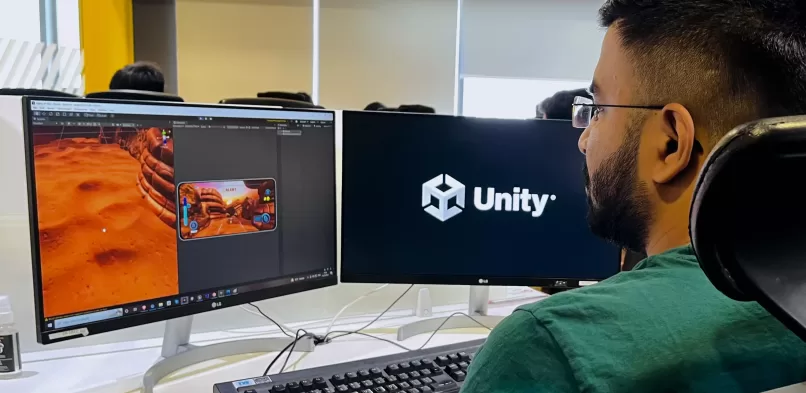
Game developer is a broad title in SA in 2027. The majority of SA game development employment falls into these roles: Unity game developer (by far the most in-demand SA role — mobile games, indie PC games, interactive simulations, VR experiences), Unreal Engine developer (less common in SA but growing — used by SA studios doing higher-fidelity console and VR work), game programmer (C# for Unity or C++ for Unreal — the backend logic, physics, AI), UI/UX designer for games, and game designer (the person who designs game mechanics, levels, and player experience — often the most creatively demanding role). Most SA entry-level game developer positions combine programming and engine skills — a SA junior game developer is expected to build systems in Unity, write clean C#, and hand off playable builds.
Unity
Dominant SA game engine 2027
C#
Primary SA game dev language
Portfolio
What SA studios hire on
The 4 Stages of Becoming a SA Game Developer
1Learn the fundamentals of programming (C#)
Game development is software development with a game engine on top. Before you can make a Unity game, you need to understand variables, functions, loops, classes, and basic object-oriented programming in C#. This is the foundation — skipping it and jumping straight to game tutorials leads to cargo-culting code you don’t understand, which falls apart the moment your project diverges from the tutorial. For SA students at School of IT, the C# programming foundation is taught first, in context, with game-relevant examples. For self-studiers, Unity Learn’s C# for Beginners path is the right starting point.
2Learn Unity (engine fundamentals)
Once you have basic C# foundations, Unity’s core concepts — GameObjects, Components, the Scene system, the Inspector, Prefabs, Physics, Input, the Canvas, and Audio — become much easier to understand and retain. Unity Learn’s structured learning paths take you through the engine systematically. This stage typically takes 4–8 weeks of consistent study for SA students who already have C# basics. By the end of this stage, you can build simple, working games from scratch.
3Build your first complete game (the portfolio piece)
Your first complete, playable, published game is the most important thing you will do as an SA game development student. It doesn’t have to be impressive — it has to be finished and playable. A simple 2D platformer, a top-down shooter, or a puzzle game that someone who isn’t you can download and actually play is worth more than 50 tutorial projects you never completed. SA game development students who publish their first complete game on itch.io have already separated themselves from the majority of people who say they’re “learning game development.”
4Build 1–2 more games showing range and depth
After your first game, build one or two more that show SA studios something different — a different genre, a more complex system, a game that shows you understand game feel, visual polish, or multiplayer. Each game is a conversation piece in a SA game developer job interview. SA studios in 2027 looking at junior candidates ask about games in the portfolio — why you built this, what was hard, how you solved it. Three complete games with real answers to those questions is a compelling SA game developer job application.
SA Game Developer Training — Comparison 2027
| Training Option | Time to Employment-Ready | Cost | Live SA Support |
|---|
| Unity Learn + YouTube (self-paced) | 12–24 months | Free | None |
| Udemy structured course | 8–18 months | R100–R2,000 | None |
| School of IT — Live 1-on-1 | 4–12 months | Get a quote | Yes — SA instructor live |
| AFDA / SAE game design degree | 3–4 years | R45,000–R180,000+ | Yes — group lectures |
Why live 1-on-1 training is the fastest path in SA in 2027: Game development learning has a specific challenge — it’s easy to follow along with a tutorial and feel like you’re learning, then hit a blank project and not know where to start. The critical skill is game development problem-solving: how to debug physics that aren’t working, how to structure a game system you haven’t built before, how to decide what to build next. That skill develops fastest when you have a SA instructor to work through problems with in real time, not days after you posted in a forum. School of IT’s live 1-on-1 model means every session you’re actively building, not watching someone else build.
Become a Game Developer With a SA Instructor — School of IT
Live 1-on-1 game development training in Unity and C#. Build real games. Build a real SA game developer portfolio. No matric. No prior experience. Start your SA game dev career in 2027.
View Game Development Courses